Am praying, as are so many others, for the people of Ukraine.
Friday, February 25, 2022
Saturday, February 12, 2022
My father, and January 1st
Since the start of the year I've only posted twice, in this space. Both posts consisted of photographs of my father.
Below is another picture, from a family album I've had for some time: it is of my father and me, from 1984 or 1985. My father was in his sixties; I was in my late twenties.
In late January, my father's wife, Anita (they became a couple in 2009, and married in 2014), sent me a number of boxes of family items, belongings of my father's I had asked for--photographs, books, files, certain objects/mementos.
I've spent much time, since then, going through the items--surprised in particular by a number of photos which had been stored away, family pictures from the 1950s and 1960s that I don't remember having seen before.
The items I received include papers and miscellanea related to my father's decades-long OB/GYN medical practice, work to which he was devoted; files concerning his two books about childbirth (one published in 1962, the other in 1971); papers and photographs from his years in the Navy; and various items from the years he spent as an actor, which began toward the end of his private practice (when he stepped away from the obstetrical part of his work, and therefore had a far more predictable schedule). He appeared, over the course of thirty-plus years, in community (and some professional) theater, in Boston and throughout Greater Boston. His acting (which also included work in independent films) continued into his nineties.
In November, I went to Massachusetts to see him. Anita had to go out of town for a brief trip, and--in that I had recently mentioned coming for a visit--she suggested I drive up at that time, to keep him company while she was away.
Four months earlier, in July, he had turned 100.
I cannot say he was in great condition, during the November visit. As had been true for a while, he tired very easily, and had a lot of difficulty walking. His memory, intermittently, was not what it once had been; this had also been true for some time.
At one point during the visit--this took place, really, out of the blue--we started singing some songs. It became the theme, of sorts, of the visit.
I'd begin singing something, say, by Frank Sinatra and Tommy Dorsey--such as, "Everything Happens to Me"--and we would take turns with the lyrics.
I sang, "I make a date for golf..."
And my Dad sang, "...and you can bet your life it rains."
Me: "I try to give a party..."
Dad: "...and the guy upstairs complains."
Me: "I guess I'll go through life..."
Dad: "...just catching colds and missing trains."
Both of us: "Everything happens to me..."
We did this for a good while, sang songs my Dad particularly liked: "Pennies from Heaven," "Love Is Here to Stay," "About a Quarter to Nine," others.

I went to the piano in the apartment, and played a few more songs that we sang to.
Later, he became tired, and lay down in the bedroom. I took out my iphone, lay down on the bed too, and found songs on YouTube. I played them for him, and we sang along with the singers: Sinatra, Al Jolson, others. He was a bit mystified as to what YouTube was, but was clearly delighted by it.
The visit, which took place over a few days, was one of the nicest times we ever spent together. It would be the last time we saw each other.
On the last day of December, having become ill, he had to go to the emergency room of the local hospital. There were no rooms available, however, because of the number of Covid patients who had been admitted. He was therefore treated in an area of the emergency room, and remained there. He was, as described to my brother and me, in good spirits--joking with the nurses, for example. Yet his condition deteriorated. He went to sleep, and then, we were told, died in his sleep, before five in the morning on New Year's Day.
I have not felt able, since his death, to write anything about him here, other than posting the various pictures of him.
My father was obviously not a young man when he died; he had a very long (and very good) life. One cannot be entirely surprised when someone who is 100 dies.
Yet, a month and a half later, there remains a sense (I am sure familiar to many) of dislocation, or perhaps disorientation; a feeling that life has taken on an odd, foreign aspect. I don't doubt that this pall--and the sense of melancholy--will remain for a good while.
*******************************************************
("Everything Happens to Me," music by Matt Dennis, lyrics by Tom Adair, 1940, © Universal Music Publishing Group)
(Photo, above, by Suzanne Fielding)

Friday, January 21, 2022
Photographs, continued
The first picture below, which I like very much, is unfortunately damaged, with scratches and tears.


(Photos, from top: My brother--wearing hat--and me, with our father [from December 1956, as noted above the picture, in a family photo album]; My parents, photographed in 1959 or 1960; Photo from telecast of "The Paul Benzaquin Show," talk show, WNAC-TV, Boston, 1970s. Paul Benzaquin is at left; my father, a frequent guest on the program, is framed by some sort of device [perhaps the casing of a not-in-use teleprompter, or something similar?], photo by Jed Fielding; and my father, in July of 2021, on his 100th birthday, photo by Bill Brett)
Friday, January 14, 2022
Photographs of my father

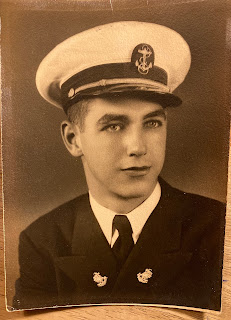
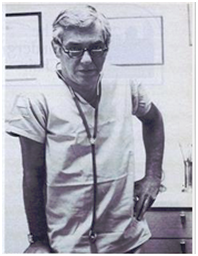
(Top photo: as a young boy, Worcester, MA, 1920s; Middle photo: while in U.S. Navy, 1940s; Bottom photo: in his medical office, Brookline, MA, 1970s, photo by Jed Fielding)
Friday, December 31, 2021
Fictional Detection
The following is from the short story "Stan the Killer," by the writer Georges Simenon, from his collection Maigret's Pipe, published in the United States in 1977 (by Harcourt Brace Jovanovich); the stories were first published in France in the 1940s. The passage is from a conversation between Simenon's Paris-based detective/Inspector of Police Jules Maigret, and his boss:
"Have you a plan?"
"You know, Chief, that I gave up having ideas a long time ago. I just go about sniffing. Some people think I'm waiting for inspiration, but they're wrong. What I'm waiting for is the significant fact which never fails to emerge. The important thing is to be there when it happens and to take advantage of it."
Here, too, is a brief section from the 2020 novel/mystery Snow, by John Banville (Hanover Square Press); the novel takes place largely in County Wexford, Ireland, in 1957. Of Detective Inspector St. John Strafford, the novel's main character, Banville writes:
...His strongest drive was curiosity, the simple wish to know, to be let in on what was hidden from others. Everything to him had the aspect of a cipher. Life was a mundane mystery, the clues to the solving of which were strewn all about, concealed or, far more fascinatingly, hidden in plain view, for all to see but for him alone to recognize.
The dullest object could, for him, flare into sudden significance, could throb in the sudden awareness of itself. There were clues, and he was their detector.
Thursday, December 30, 2021
Article from a 2002 "TV Guide"
I recently looked through a copy I have of TV Guide, from April 6, 2002. The cover story was titled: "TV We'll Always Remember."
(No--simply for your reference--this is not Mitchell Hadley's site, "It's About TV," where he regularly writes about--and seeks to analyze the social and historical context of--programs and articles contained within particular TV Guide issues, from the 1950s, '60s, '70s, and beyond.)
In the 2002 issue there were recollections about television--from TV stars, TV news anchors, behind-the-scenes figures (producers, directors, writers), and others.
Comments from two of television's most influential figures were included.
One was Steven Bochco--who, as many will recall, was an executive producer, co-creator, and writer for such programs as NYPD Blue, L.A. Law, and Hill Street Blues.
He said, in 2002:
"As a boy in the '50s, I was profoundly [affected] by shows like Studio One and Playhouse 90. They were using some of the best writers, people like Paddy Chayefsky. I didn't have much opportunity as a kid to go to the theater. TV was my theater--first-rate theater. It shaped my sense of what theater was. I didn't say, 'This is what I want to do when I grow up,' but it had to have played a role. Then, when I was starting, the criticism you'd get on some scene you wrote for some series was, 'It's too wordy, it's just talking heads.' But I knew from those great old shows: It's the words first."
Mr. Bochco died in 2018, at age 74.Also featured in the article were comments from Norman Lear, who (in addition to his affiliation with many other TV programs) was the creator, co-executive producer of (and writer for) All in the Family--certainly one of television's most significant shows. Mr. Lear began his television career as a writer, in 1950; he and his then-writing partner Ed Simmons worked for such programs as Dean Martin and Jerry Lewis's Colgate Comedy Hour.
Mr. Lear said, in 2002:
"People are always talking about 'the golden age.' I think the golden age is now. But to back that up in TV terms, there's a whale of a lot of really good television out there. So many of the hour dramas are so worthwhile, so much of what HBO is doing. What's missing is music and variety. I can't tell you how much I miss music and dance--everything from Lawrence Welk to Carol Burnett to Martin and Lewis to Your Show of Shows to great variety and musical television."
At 99 years old, the legendary Mr. Lear remains active as a television producer.
Subscribe to:
Posts (Atom)

