Friday, January 21, 2022

Photographs, continued

The first picture below, which I like very much, is unfortunately damaged, with scratches and tears.


(Photos, from top: My brother--wearing hat--and me, with our father [from December 1956, as noted above the picture, in a family photo album]; My parents, photographed in 1959 or 1960; Photo from telecast of "The Paul Benzaquin Show," talk show, WNAC-TV, Boston, 1970s. Paul Benzaquin is at left; my father, a frequent guest on the program, is framed by some sort of device [perhaps the casing of a not-in-use teleprompter, or something similar?], photo by Jed Fielding; and my father, in July of 2021, on his 100th birthday, photo by Bill Brett)

Friday, January 14, 2022

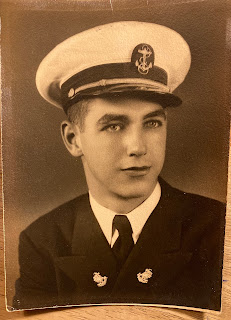
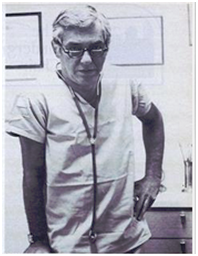
Photographs of my father


(Top photo: as a young boy, Worcester, MA, 1920s; Middle photo: while in U.S. Navy, 1940s; Bottom photo: in his medical office, Brookline, MA, 1970s, photo by Jed Fielding)

Friday, December 31, 2021

The New Year

 Good wishes for 2022...

Fictional Detection

The following is from the short story "Stan the Killer," by the writer Georges Simenon, from his collection Maigret's Pipe, published in the United States in 1977 (by Harcourt Brace Jovanovich); the stories were first published in France in the 1940s. The passage is from a conversation between Simenon's Paris-based detective/Inspector of Police Jules Maigret, and his boss:

    "Have you a plan?"

    "You know, Chief, that I gave up having ideas a long time ago.  I just go about sniffing.  Some people think I'm waiting for inspiration, but they're wrong.  What I'm waiting for is the significant fact which never fails to emerge.  The important thing is to be there when it happens and to take advantage of it."

Here, too, is a brief section from the 2020 novel/mystery Snow, by John Banville (Hanover Square Press); the novel takes place largely in County Wexford, Ireland, in 1957. Of Detective Inspector St. John Strafford, the novel's main character, Banville writes:

...His strongest drive was curiosity, the simple wish to know, to be let in on what was hidden from others. Everything to him had the aspect of a cipher.  Life was a mundane mystery, the clues to the solving of which were strewn all about, concealed or, far more fascinatingly, hidden in plain view, for all to see but for him alone to recognize.

    The dullest object could, for him, flare into sudden significance, could throb in the sudden awareness of itself. There were clues, and he was their detector.

Thursday, December 30, 2021

Article from a 2002 "TV Guide"

I recently looked through a copy I have of TV Guide, from April 6, 2002.  The cover story was titled: "TV We'll Always Remember." 

(No--simply for your reference--this is not Mitchell Hadley's site, "It's About TV," where he regularly writes about--and seeks to analyze the social and historical context of--programs and articles contained within particular TV Guide issues, from the 1950s, '60s, '70s, and beyond.)

In the 2002 issue there were recollections about television--from TV stars, TV news anchors, behind-the-scenes figures (producers, directors, writers), and others.

Comments from two of television's most influential figures were included.  

One was Steven Bochco--who, as many will recall, was an executive producer, co-creator, and writer for such programs as NYPD Blue, L.A. Law, and Hill Street Blues.  

He said, in 2002:

"As a boy in the '50s, I was profoundly [affected] by shows like Studio One and Playhouse 90.   They were using some of the best writers, people like Paddy Chayefsky.  I didn't have much opportunity as a kid to go to the theater. TV was my theater--first-rate theater.  It shaped my sense of what theater was.  I didn't say, 'This is what I want to do when I grow up,' but it had to have played a role.  Then, when I was starting, the criticism you'd get on some scene you wrote for some series was, 'It's too wordy, it's just talking heads.'  But I knew from those great old shows: It's the words first."

Mr. Bochco died in 2018, at age 74.

Also featured in the article were comments from Norman Lear, who (in addition to his affiliation with many other TV programs) was the creator, co-executive producer of (and writer for) All in the Family--certainly one of television's most significant shows. Mr. Lear began his television career as a writer, in 1950; he and his then-writing partner Ed Simmons worked for such programs as Dean Martin and Jerry Lewis's Colgate Comedy Hour.

Mr. Lear said, in 2002:

"People are always talking about 'the golden age.' I think the golden age is now.  But to back that up in TV terms, there's a whale of a lot of really good television out there.  So many of the hour dramas are so worthwhile, so much of what HBO is doing.  What's missing is music and variety.  I can't tell you how much I miss music and dance--everything from Lawrence Welk to Carol Burnett to Martin and Lewis to Your Show of Shows to great variety and musical television."

At 99 years old, the legendary Mr. Lear remains active as a television producer.

Friday, December 24, 2021

Christmas

Here is Judy Garland's recording of "Have Yourself a Merry Little Christmas," from 1944.  

She introduced the song in the 1944 film Meet Me in St. Louis.

https://www.youtube.com/watch?v=NLnjvEUJ_FA

Merry Christmas...

Wednesday, December 22, 2021

Beverly Kenney, Ellis Larkins, & Ella Fitzgerald

An automobile commercial has been airing for a while on TV (for Lincoln). It features part of a very lovely vocal rendition of the song "It's a Most Unusual Day."

https://www.youtube.com/watch?v=EVDW5KfRqFk

In listening to the commercial, the singer's voice sounded familiar to me--but I was mistaken. I learned, online, that the vocalist was Beverly Kenney.  I was not familiar with her name.

Ms. Kenney recorded "It's a Most Unusual Day" in 1957, accompanied by the much-admired pianist Ellis Larkins. The song appeared on her 1958 album, "Beverly Kenney Sings For Playboys."

https://www.youtube.com/watch?v=4vK_eS0sqGw

Ms. Kenney was born in New Jersey in 1932. She recorded several albums in the mid-to-late 1950s, and received critical praise for her work. She died in New York in 1960, at age 28, by suicide.

In Japan, according to Wikipedia, she "remains a cult figure."

https://en.wikipedia.org/wiki/Beverly_Kenney

As noted above, Ellis Larkins was the pianist for Ms. Kenney's "It's a Most Unusual Day"--as well as being featured on the other songs on her 1958 album (along with bassist Joe Benjamin).  Mr. Larkins is perhaps best known for his work with Ella Fitzgerald--including accompanying her on the 1950 album "Ella Sings Gershwin." The album's opening song is one of the most exquisite recordings I've ever heard (a recording I've mentioned previously in this space): it is of Ms. Fitzgerald, and Mr. Larkins, performing "Someone to Watch Over Me."  

Here is the 1950 recording of the song:

https://www.youtube.com/watch?v=TYEeAOTIQ2c

Here, too, is the Wikipedia page about Mr. Larkins:

https://en.wikipedia.org/wiki/Ellis_Larkins

Mr. Larkins died in 2002, at age 79.  Ella Fitzgerald died in 1996, at 79.